
Chat With Us
Flexible Piezo Release
Back to Resources

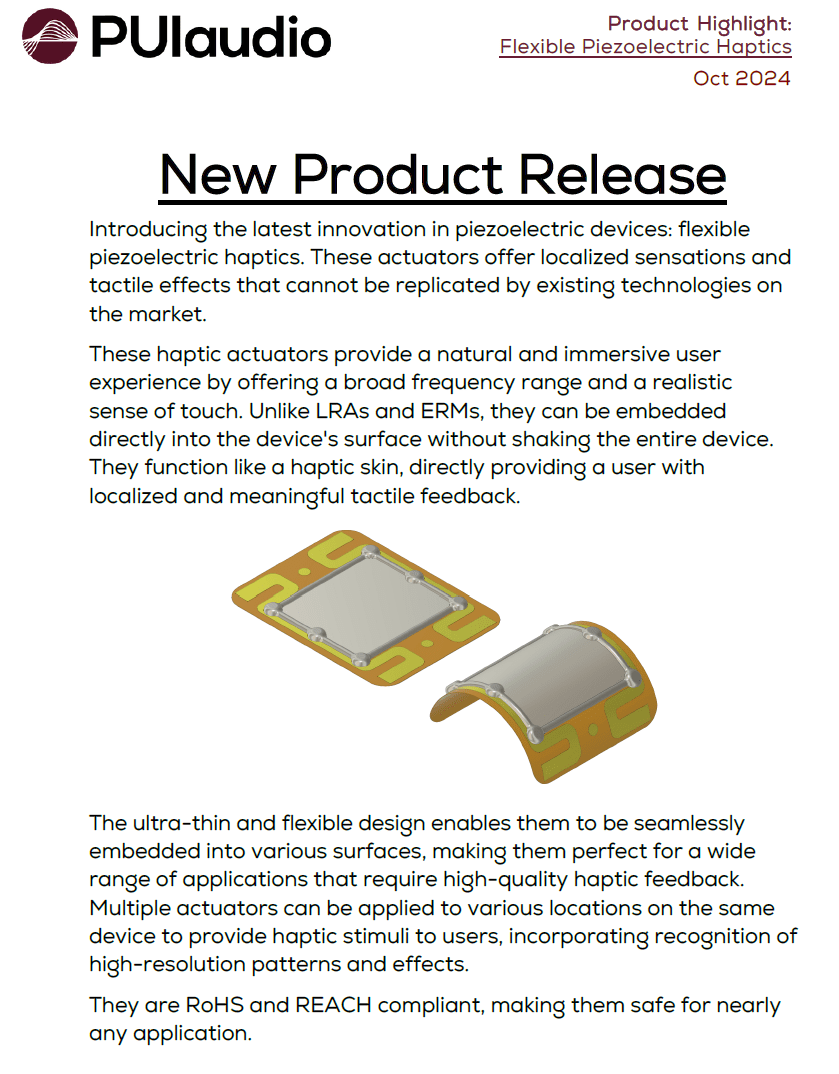
Introducing the latest innovation in piezoelectric devices: flexible piezoelectric haptics. These actuators offer localized sensations and tactile effects that cannot be replicated by existing technologies on the market.
These haptic actuators provide a natural and immersive user experience by offering a broad frequency range and a realistic sense of touch. Unlike LRAs and ERMs, they can be embedded directly into the device’s surface without shaking the entire device. They function like a haptic skin, directly providing a user with localized and meaningful tactile feedback.
The ultra-thin and flexible design enables them to be seamlessly embedded into various surfaces, making them perfect for a wide range of applications that require high-quality haptic feedback. Multiple actuators can be applied to various locations on the same device to provide haptic stimuli to users, incorporating recognition of high-resolution patterns and effects.
They are RoHS and REACH compliant, making them safe for nearly any application.
The foundation of traditional piezoelectric haptics is the piezo bender. A lead zirconate titanate (PZT) crystal is coated with silver on both sides and glued to a brass, nickel alloy, or stainless-steel disk.
Based on the reverse piezoelectric effect, these actuators consist of layers of acti ve piezoelectric ceramic that bend and contract outward when voltage is applied. Attaching this piezoelectric material to a base metal or a substrate causes an out-of-plane displacement when voltage is applied. This physical displacement generates the haptic feedback experienced by the user-the extent of which is directly influenced by the capacitance of the piezoelectric system.
Capacitance refers to the piezo bender’s ability to store electrical charge. It is determined by the properties of the piezoelectric material (e.g., PZT), the surface area of the electrodes (coated with silver), and the thickness of the piezoelectric layer.
A higher capacitance allows storing more charge at a given voltage, enhancing the electric field across the piezoelectric material. This electric field leads to more deformation of the piezo layer, increasing the displacement and the intensity of haptic feedback. A piezo benders’ haptic performance relies on finding an optimal balance between the capacitance and the applied voltage to achieve the desired displacement without overloading the system.
PUI’s flexible piezoelectric actuators are constructed using a different method, utilizing similar manufacturing processes to those found in film capacitors. Instead of dielectric material typically found in capacitors, these devices utilize an electro-active polymer (EAP). When activated with an electric field, the EAP realigns its molecules in a direction that elongates the film, displaying a piezoelectric effect.
When the EAP layer is adhered to a flexible substrate, a displacement will occur perpendicular to the direction of the EAP’s elongation. This type of piezoelectric actuator typically has large capacitance, requiring high voltage levels (couple of hundreds of volts) to achieve the desired displacement.
PUI’s flexible actuator contains a proprietary polyvinylidene fluoride compound which reduces the capacitance of the EAP. This allows displacement required for high-resolution haptic effects to be possible at voltage levels typically used with piezoelectric haptic actuators.
PUI Audio’s flexible piezoelectric actuators also have a superior frequency response compared to other traditional electromagnetic or piezoelectric offerings and can handle an increased range of frequencies. This flexibility allows them to reproduce rich low-frequency vibrations that provide pleasant tactile sensations and higher frequencies necessary for including intricate details.
Perception of haptic effects caused by vibration varies among individuals due to differences in sensory sensitivity. The fingertips, especially the pads, are among the most sensitive parts of human skin, capable of detecting transient displacements as small as a few nanometers. These areas can perceive a wide range of vibration, typically from 20 Hz to over 800 Hz, with a maximum sensitivity of around 250 Hz. Our actuator has been specifically engineered to maximize performance in these relevant frequency ranges.
This means the PAF-1419 can convey specific material textures and familiar sensations to users more naturally than other devices. Specific waveforms can be designed to convey impacts of any type – such as the click of a button or dice rolling across a table – or more complex haptic stimulus, like feeling water ripple across the hand.
Download Full Article